As I awake on this National Day of Mourning, I am reminded of pre-colonial and post-colonial Thanksgiving in the United States. At its core, Uprooting Qahr! Power, Priviledge, and Paperwork centers truth telling across generations, geographies, and identifies to remember, repair, and reconcile.
Today, we honor the legacy and life of the over 90 million Indigenous people displaced, dispossessed, disenfranchised, discriminated, and killed in service of the ‘American Dream.’
Today, we identify meaningful ways to repair and reconcile with Indigenous people and Tribes in our personal and professional lives.
Today, we also remember pre-colonial traditions of Thanksgiving across Indigenous Nations too and reclaim the mutual dependence and interconnection with each other and our more than human kin.
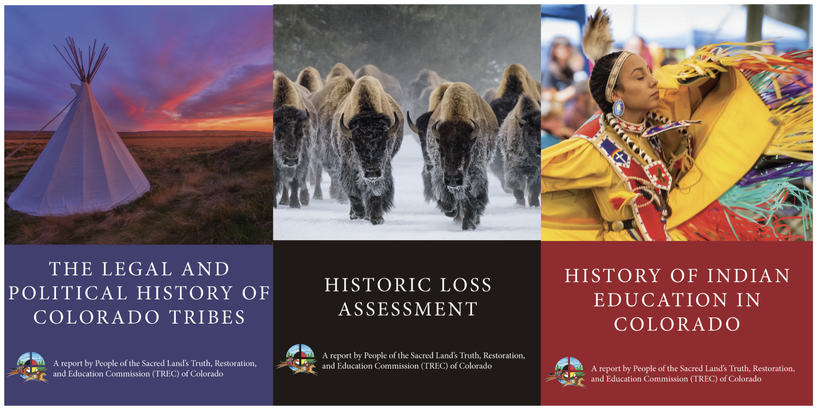
Today, I share “A Story of Thanksgiving ” by Rick Williams. Rick leads the People of the Sacred Land Commission which wrote the Truth, Restoration, and Education Reports about Colorado Tribes. Rick has strong calls to action as well provided in those reports which outline the political and legal history, the historic loss assessments, and American Indian Education. I highly recommend purchasing the reports here.
“A Story of Thanksgiving” By Rick Williams
Although we celebrate Thanksgiving in America as a celebration of an event in which “Indians” helped the Pilgrims, the concept of Thanksgiving was a common practice of Indian nations and communities long before the Pilgrims came to America. It is distinctly possible that the first Thanksgiving with the Pilgrims came at a time when Indian communities were celebrating and giving thanks for “Indian Summer”. Indian summer is a time during the fall when Indian communities would celebrate a second harvest of their gardens. This usually occurs during a period of warmth (usually after a cold spell or even snow) where the community would go back to the gardens and gather the vegetables that were missed or not fully ripe during the earlier harvest. These warm days and the gift of extra food from the creator brought great joy to the people. A thanksgiving ceremony usually followed. So, it makes sense that the First Thanksgiving with the Pilgrims took place in the fall.
The real story of that first Thanksgiving although filled with happiness for the Pilgrims was actually a very difficult time for Indian communities. Many Native Nations on the eastern seaboard were devastated by diseases such as smallpox and many villages were now uninhabited and the former inhabitants extinct. I do not believe I have read a single story that acknowledges the first pandemic in America and how it killed millions of people. Indian people today will always remember the holocaust that left so many of our relatives dead from diseases.
Here is a part of the history and story of Thanksgiving that is rarely told in America today.
One day in 1605, a young Patuxet Indian boy named Tisquantum and his dog were out hunting when they spotted a large English merchant ship off of the coast of Plymouth, Mass. Tisquantum, who later became known as Squanto, had no idea that life as he knew it was about to change forever.
His role in helping the Pilgrims to survive the harsh New England winter and celebrate the “first” Thanksgiving has been much storied as a legend of happy endings, with the English and the Indians coming together at the same table in racial harmony. Few Americans, however, know the story of Squanto’s sad life and the demise of his tribe as a result of its interaction with the Europeans.
This year as we sit down to celebrate that First Thanksgiving with the Pilgrims we should also tell the story of Squanto and the fate of the Patuxet tribe.
Squanto’s fateful journey to infamy begins the day that Capt. George Weymouth who was anchored off the coast of Massachusetts, Weymouth and his sailors captured Squanto and four other tribesmen and took them back to England as slaves because Weymouth thought his financial backers “might like to see” some Indians. Squanto was taken to live with Sir Ferdinando Gorges, owner of the Plymouth Company. Gorges quickly saw Squanto’s value to his company’s exploits in the new world and taught his young charge to speak English so that his captains could negotiate trade deals with the Indians.
In 1614, Squanto was brought back to America to act as a guide and interpreter to assist in the mapping of the New England coast, but was kidnapped along with 27 other Indians and taken to Malaga, Spain, to be sold as slaves for about $25 a piece. When local priests learned of the fate of the Indian, they took them from the slave traders, Christianized them and eventually sent them back to America in 1618.
But his return home was short-lived. Squanto was recognized by one of Gorges’ captains, was captured a third time and sent back to England as Gorges’ slave. He was later sent back to New England with Thomas Dermer to finish mapping the coast, after which he was promised his freedom. In 1619, however, upon returning to his homeland, Squanto learned that his entire tribe had been wiped out by smallpox contracted from the Europeans two years before. He was the last surviving member of his tribe.
In November 1620, the Pilgrims made their now-famous voyage to the coast of Plymouth, which had previously been the center of Patuxet culture. The next year, on March 22, 1621, Squanto was sent to negotiate a peace treaty between the Wampanoag Confederation of tribes and the Pilgrims. We also know that Squanto’s skills as a fisherman and farmer were crucial to the survival of the Pilgrims that first year – contributions which changed history.
But in November 1622, Squanto himself would succumb to smallpox during a trading expedition to the Massachusetts Indians. The Patuxet, like so many other tribes, had become extinct. The lesson of Squanto and the Pilgrims is not one of bitter remembrance, but rather a celebration of the generosity of Indian people. Under the guidance of Squanto, the Pilgrims followed a longstanding Indian tradition of offering thanks. Although we celebrate Thanksgiving as an “American” holiday, its beginnings are Native to the core.
Feasts of gratitude and giving thanks have been a part of Indian culture for thousands of years in Lakota culture, it’s called a Wopila; in Navajo, it’s Hozhoni; in Cherokee, it’s Selu i-tse-i; and in Ho Chunk it’s Wicawas warocu sto waroc. Each tribe, each Indian nation, has its own form of Thanksgiving. But for Indian culture, Thanksgiving doesn’t end when the dishes are put away. It is something we celebrate all year long – at the birth of a baby, a safe journey, a new home.
In America today, we are facing many of the challenges faced by those Pilgrims long ago. Our economy is nearing depression level, financial institutions once the pillar of the American financial systems are facing almost insurmountable trouble. Our infrastructure is crumbling around us. A single hurricane brought such devastation that the area still has not fully recovered. Our world rankings in higher education and especially in science, math and technology are no longer notable and are slipping each year. Our K-12 educational system is in trouble. And we have global warming. Perhaps we should reflect back to that day long ago when those helpless Pilgrims sought support from the Indian nations living in the area. Giving is a way of life for Indian people and philanthropy is now common in America but does not exist in many foreign countries. American Indians helped our fellow Americans understand generosity when we gave up this country.
The very food that was shared on that day had been developed and in some cases genetically improved long before the Pilgrims came to America. That indigenous knowledge helped improve the world then and now. Where would we be without food stables such as corn, squash, beans, chilies, tomatoes and the ubiquitous potato?
Everyday our lives are enriched by the variety of foodstuff and many lives saved or made more comfortable by medicines such as aspirin and quinine.
Back then Squanto and the Paxuet’s knew and understood the need to live in harmony with the environment. It is common knowledge among Indian nations that we must treat our Mother Earth as a living, breathing sacred being and we must never take more than we give back while living in harmony with our world and each other. These lessons are more important today if we are going to survive.
So, when you sit down to Thanksgiving dinner this year, remember Squanto and the great sacrifices made by him and his tribe to a people they didn’t know. And even more important we should outlawed colonization.
Rick Williams is Lakota/Cheyenne elder, a historian, and educator
Afterthought= Generosity as a way of life
Generosity is a way of sharing wealth, honors and reducing hunger. In Native communities we also share famine, grief, tragedies, and disasters. We gave our best possessions to the poorest and neediest; sharing wealth and also sharing the burdens of life. That is how we survived and continue to exist. In the words of Lakota wisdom keeper, Joe Marshall “Kilaka Yelo!”
“Keep Going”
Richard B. Williams
People of the Sacred Land, President